


The Mariinsky Theatre’s eventful 243rd season is drawing to a close. The theatrical year at Mariinsky II will conclude on 6 August with the premiere performance of Eldar Aliev’s production of Romeo and Juliet, presented as part of the Primorsky Stage’s tour. The final events of the summer at the Historic Stage will be performances of Tchaikovsky’s Swan Lake by the Leonid Yacobson Ballet Theatre on 7 (at 13:00 and 19:00), 8 (at 13:00 and 19:00), 9 August (at 13:00 and 19:00).
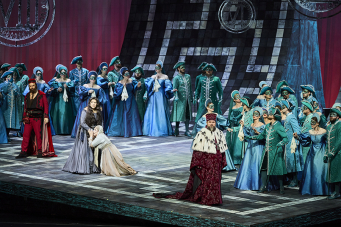
The season’s artistic achievements include seven major premieres and two eagerly awaited revivals. Audiences saw new large-scale productions of Musorgsky’s Boris Godunov and Ponchielli’s La Gioconda, created by the celebrated Bulgarian team of stage director Orlin Anastassov and set designer Denis Ivanov. The Concert Hall welcomed two productions conceived especially for its space: Rimsky-Korsakov’s The Golden Cockerel, directed by Anna Shishkina, and Rachmaninoff’s The Miserly Knight, directed by Alexander Ponomaryov. To mark the 270th anniversary of Mozart’s birth, the theatre presented Idomeneo, rè di Creta in a production by Roman Kocherzhevsky.
The ballet repertoire was enriched by the premieres of Vyacheslav Samodurov’s Round Dances, set to music by Shchedrin, and a Mariinsky version of Leonid Yacobson’s Brilliant Divertissement to music by Glinka. Two long-awaited works also returned to the playbill: Boris Tishchenko’s ballet Yaroslavna. The Eclipse, choreographed by Vladimir Varnava, and Roland Petit’s iconic Le Jeune homme et la mort, set to music by Bach.
More than 2,000 events took place across the Mariinsky Theatre’s St Petersburg venues during the 243rd season: 434 ballet performances, 600 opera performances, 370 concerts and 711 cultural and educational programmes, including lectures, practical theatre studies sessions, events for children, and backstage tours of the Historic Stage and Mariinsky II, which have become immensely popular with residents and visitors to St Petersburg alike. Around two million people attended the theatre over the course of the season.
Among the Mariinsky’s major initiatives this season were the Mozart 270 project, a series of themed days devoted to outstanding composers – Modest Musorgsky, Pyotr Tchaikovsky and Rodion Shchedrin – and A Weekend with Verdi. Richard Wagner’s monumental tetralogy Der Ring des Nibelungen was performed twice. The theatre also marked dozens of anniversaries associated with works, productions, great composers and artists.
The Mariinsky’s renowned annual festivals continued as well: the XIII Mariinsky International Organ Festival; the XX Mariinsky International Piano Festival; the X Virtuosi of the Flute & Northern Lyre International Festival; and the XXXIV Stars of the White Nights Music Festival.
Two major festivals presented jointly with the Bolshoi Theatre of Russia deserve particular mention: Maya and Rodion, honouring the memory of the great Maya Plisetskaya and Rodion Shchedrin, and Prokofiev: One of Our Own, marking the anniversary of the great composer’s birth.
“Prokofiev’s 135th anniversary could simply have been marked with a few commemorative events in April. Instead, we decided that our two theatres should celebrate this perhaps not especially round but extremely important anniversary on a truly grand scale. I believe this is the right and most interesting way forward today. New generations of artists are emerging, and exchanges between the two theatres give performers the opportunity to appear in an extraordinary range of works. By joining our creative forces and enriching the programmes of both theatres, we replace competition with cooperation – and that is enormously valuable,” says Valery Gergiev.
Russia’s two leading musical theatres continued their close collaboration and fruitful artistic exchange throughout the season. The Bolshoi Theatre brought Shostakovich’s The Bright Stream and Auber’s Marco Spada to St Petersburg. In Moscow the Mariinsky presented Verdi’s Simon Boccanegra, Donizetti’s Lucia di Lammermoor in concert, Prokofiev’s War and Peace and The Fiery Angel, Rimsky-Korsakov’s Christmas Eve, Tchaikovsky’s Eugene Onegin and Wagner’s Parsifal. Many of these performances featured soloists, chorus, mime ensemble, and orchestra of the Bolshoi Theatre.
The Mariinsky’s The Legend of Love by Melikov ceremonially opened the XV International Ballet Competition at the Bolshoi Theatre. Other joint projects during the season included Prokofiev’s operas The Love for Three Oranges, Betrothal in a Monastery and The Gambler, all presented at the Bolshoi.
Together, the two companies also undertook two major projects away from their home stages: the XXV Moscow Easter Festival and the III Genius of Place Festival.
The anniversary edition of the Moscow Easter Festival was the largest in its history. Over twenty-nine days Valery Gergiev and a combined symphony orchestra of the Mariinsky and Bolshoi theatres travelled more than 20,000 kilometres as part of the symphonic programme, performing in almost forty Russian towns and cities.
The third season of Genius of Place, a festival of musical tributes held in the birthplaces of great composers, also set avrecord. This year its geography encompasses seven cities: Veliky Novgorod, Pskov, Tikhvin, Votkinsk, Smolensk, Oranienbaum and St Petersburg. The festival will conclude ceremonially in the autumn with celebrations marking the 120th anniversary of the birth of Dmitri Shostakovich.
The events are held with the support of the Presidential Fund for Cultural Initiatives, the Ministry of Culture of the Russian Federation, and ROSCONCERT.
Another first this season saw leading dancers from the Mariinsky and Bolshoi theatres perform together at the Mariinsky Far East Festival in Vladivostok.
More than 200,000 people attended the Primorsky Stage of the Mariinsky Theatre during the season. Its programme comprised 119 ballet performances, 182 opera performances and thirty-five concerts.
The season brought a wealth of premieres: Banevich’s opera The Story of Kai and Gerda; Puccini’s La bohème in concert; and the ballets La Fille mal gardée, to music by Hérold, and Prokofiev’s Romeo and Juliet. The world premiere of Alexander Smelkov’s cantata God’s Pipe took place, while the project A Portrait of a Singer in an Interior made a successful return to the Chamber Hall.
The Primorsky Stage also held two major festivals: the X Mariinsky International Far East Festival and the III Far East Easter Festival.
Over the course of the season the Primorsky Stage company gave more than 350 performances both at home and on tour. Its touring geography encompassed St Petersburg, Khabarovsk, Yuzhno-Sakhalinsk, Komsomolsk-on-Amur, Artyom, Partizansk, Bolshoy Kamen, Korsakov and the village of Knyaze-Volkonskoye.
The Mariinsky Theatre’s branch in the Republic of North Ossetia–Alania welcomed almost 60,000 visitors, presenting thirty-four ballet performances, seventy-four opera performances, 113 concerts and thirty-five guided tours.
Its premieres included Vladimir Milov’s opera Ali Baba and the Forty Thieves and the ballet The Count of Monte Cristo to music by Édouard Lalo; the branch also gave the concert premiere of a production of Puccini’s La bohème.
This season also saw the launch of a new festival, The Beginning of Immortality, dedicated to the memory and courage of generations. Other major events included the VII Mariinsky–Vladikavkaz International Festival, the Choral Music Festival marking the centenary of the outstanding Ossetian composer and arts figure Arkady Acheyev, and the XXV Moscow Easter Festival.
The company toured to St Petersburg, including Kronstadt, as well as Pskov, Astrakhan and Odintsovo.
The St Petersburg company’s touring programme reached a record nine cities in China this year: Beijing, Nanjing, Shanghai, Wuhan, Kunming, Changsha, Xi’an, Shenzhen and Yanguan. Performances also took place in Yerevan, Dubai, Moscow, Kazan, Irkutsk, Tikhvin, Pushkinskiye Gory, the Sirius Federal Territory, Vladivostok and Vladikavkaz.
At its own venues during the 243rd season the Mariinsky welcomed more than forty visiting companies from Russia, China, Türkiye, Uzbekistan and Armenia.
One of the highlights of the summer at the Historic Stage was the inter-union concert Music of the Theatre, marking the 150th anniversary of the Union of Theatre Workers of Russia. Masterpieces of world music were presented within a visual environment inspired by the art of the future and technological innovation.
The concert continued the Mariinsky’s active exploration of ways in which classical music can engage with contemporary technology. During the 243rd season the theatre gave the first public performances of Mandragora, an opera created with the aid of artificial intelligence. It also premiered a new production of Idomeneo, rè di Creta, bringing together the world of antiquity and innovative stage design, and presented the unique project Symphony of Innovation, which combines classical music with cutting-edge technology.
The Stravinsky Hall – the Mariinsky Theatre’s newest and fourth-largest performance venue in St Petersburg – became a true centre of attraction for the city’s music lovers this season. Bright, welcoming and multifunctional, with exceptional acoustics, the hall consistently offers programmes of the highest calibre and impresses even the most discerning audiences.
Today it not only introduces listeners to promising young artists but also offers the opportunity to encounter internationally renowned performers in a more intimate and informal setting. At the same time it serves as a kind of creative laboratory: new additions to the Mariinsky Theatre’s repertoire are often heard here first, alongside exclusive programmes that in many cases can be experienced nowhere else but the Stravinsky Hall.





| user_name | | Exit |