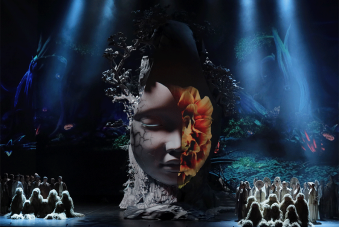



On 6 and 7 March (at 12:00 and 19:00) the New Stage of the Mariinsky Theatre will host performances of the mystical opera Mandragora by Tchaikovsky–Dranga, created with the assistance of artificial intelligence. The world premiere took place on 19 June 2025 at Mariinsky II as part of the St Petersburg International Economic Forum, where it became one of the most widely discussed events. Now audiences will have the opportunity to experience this unique work.
The idea for the opera Mandragora arose after Pyotr Tchaikovsky became acquainted with Professor of Botany Sergey Rachinsky. A man of many talents, Rachinsky was also a mathematician and folklorist who wrote extensively on the arts, including literature and music. He authored the libretto of Mandragora. Although the complete text has not survived, a synopsis reached us through a letter Rachinsky wrote to the composer’s brother, Modest Tchaikovsky.
Mandragora became one of Tchaikovsky’s fantastical stage works that he left unfinished. “I was ready to undertake this libretto, but friends dissuaded me, insisting the opera would prove unstageable,” the composer wrote. The only completed fragment is the evocative and magical Chorus of Flowers and Insects on Ivan Kupala Night. It was first performed in Moscow on 18 December 1870 under the baton of Nikolai Rubinstein.
Today, a century and a half later, modern technology offers audiences the chance to glimpse what Mandragora might have been. Composer Peter Dranga, together with artificial intelligence, has completed Tchaikovsky’s opera. A neural network assisted in reconstructing the libretto as well as in developing the scenography and costume designs. Dranga rebuilt the opera’s structure and composed additional music and text, drawing on the surviving materials and the artistic language of Tchaikovsky and Rachinsky.
“The creation of Mandragora demanded the utmost respect for its source and a deep immersion in the style of Tchaikovsky and Rachinsky. Artificial intelligence became an important partner in this process: it helped structure the dramaturgy and refine the visual imagery and stage design. When technology makes it possible to hear the voice of an era, it is not magic – it is true art,” noted Peter Dranga.
The production is directed by Ilya Ustyantsev, with choreography by Dmitry Pimonov. The chorus master is Konstantin Rylov; the répétiteur in charge is Yevgenia Isupova.





| user_name | | Exit |